
How to Compare Monthly Developer Hiring and Permanent Staff Costs
Compare monthly developer hiring and permanent staff costs, including recruitment, tools, internal management, quality review, and knowledge transfer.

When a project needs more developers, organizations often begin by comparing an employee's salary with an external provider's monthly fee. Those figures may cover different work and responsibilities, so the monthly amount alone cannot establish which option suits the project.
A useful comparison starts with the same work, skills, timeframe, and acceptance criteria. Gather the relevant expenses, including the time your internal team needs to manage and review the work. Then consider staffing continuity and the knowledge the organization needs to retain.
This article provides a framework for comparing monthly developer hiring with permanent employment. It uses your organization's information and actual proposals so that business, HR, and technical teams can work from the same assumptions.
Define the work and skills before comparing prices
Required roles and experience
Start with the deliverables, such as frontend development, API integration, system architecture, or testing. Clarify whether the developer will implement already defined tasks or also analyze problems and make decisions. These responsibilities affect the skills you need.
Comparing people with different levels of experience or different responsibilities can make prices look inconsistent without explaining why. State your expectations, including the technologies involved, the problems the person will handle, and who will assess technical suitability.
Duration and workload
Distinguish between work for a particular project phase, core work that needs long-term ownership, and uncertainty in the roadmap. If you do not yet know how much ongoing work there will be, record that assumption in the comparison and set review points instead of assuming the same workload every month.
Use the same comparison period for both options. Specify the expected start date and the data or systems that must be prepared. Include recruitment and onboarding in the schedule to show their effect on delivery dates, but assign an additional monetary cost only when you have a supported calculation.
Responsibilities that remain with your organization
Confirm who manages requirements, prioritizes the backlog, makes technical decisions, and accepts the work. If you are hiring a developer only, these duties may remain with your internal team. Proposals that include management and QA should itemize those responsibilities. Service packages can include different things.
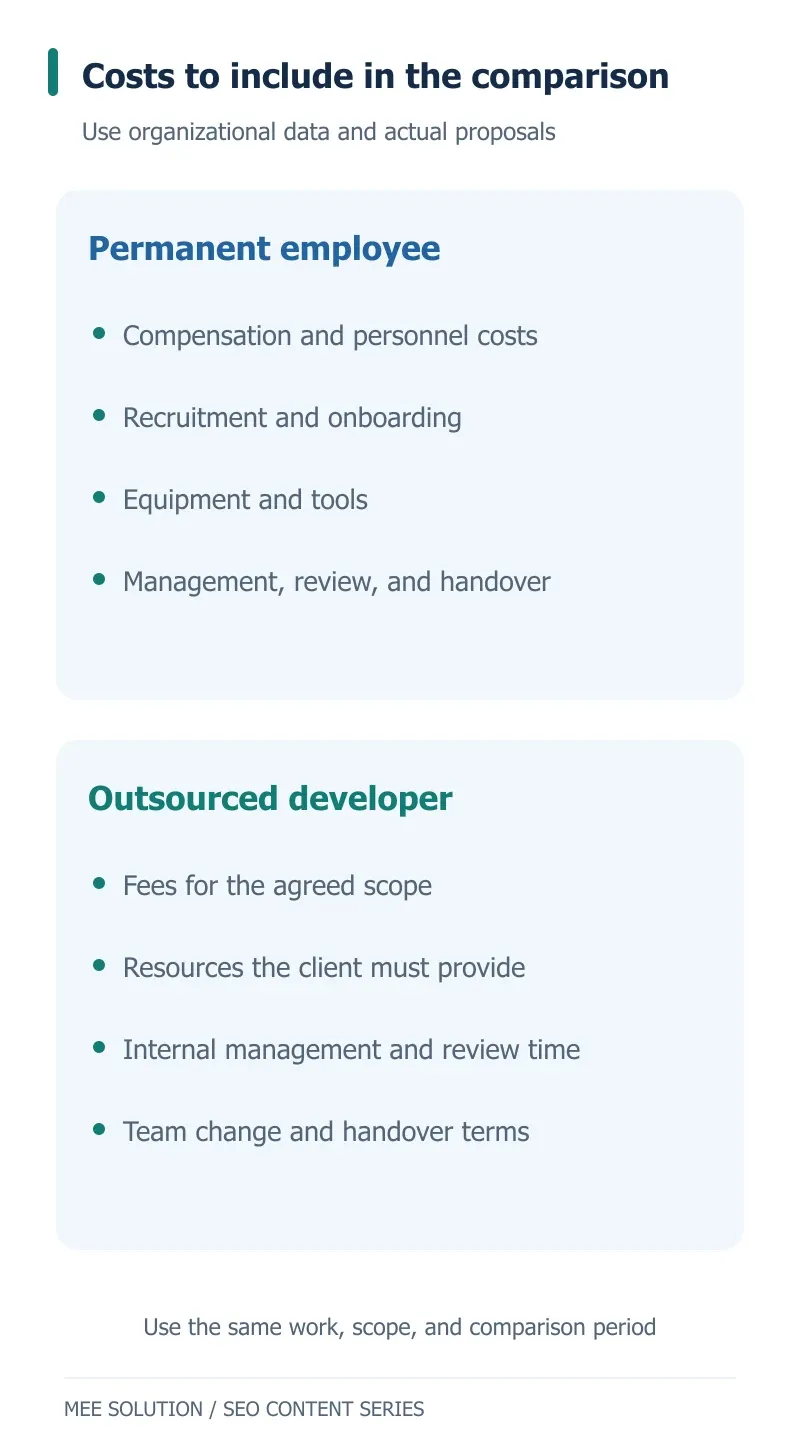
Check the actual scope of both options.
Compare compensation, recruitment, onboarding, tools, and management with outsourced fees, client resources, internal time, and handover. Use the same work and timeframe.
Costs to include when hiring a permanent developer
Begin with compensation and personnel costs that your organization covers under its employment terms and policies. Use HR or finance information for the relevant role. Separate monthly costs from periodic or occasional expenses.
For recruitment, gather actual expenses and the time people spend interviewing candidates or assessing skills. Record that time in hours first. If you convert it into a monetary amount, document the rate and check that the same cost is not already included elsewhere in personnel expenses.
Review equipment, licenses, test systems, and access setup as well. Separate equipment you already own and can continue using from new purchases. This shows both the new spending required and the resources that must be allocated.
After the person starts, allow for onboarding, system explanations, skills development, and quality review. Assign owners and time for these activities. Permanent hiring may also suit work that requires accumulated business knowledge and ongoing product ownership. Assess those needs alongside the budget.
What an outsourced developer fee includes
Check the scope of the fee
Read the proposal for the role, working arrangements, reporting method, and provider support. Check what happens if the assigned person is unavailable or needs to be replaced. Terms vary between providers, so obtain written answers before comparing proposals.
Identify what your team must provide
IT staff augmentation still requires work that is ready to begin, people who can supply information, access to systems, and someone to review the results. If your internal product owner or tech lead needs to contribute time, include that effort in the plans for both permanent hiring and outsourcing according to the actual scope.
Confirm who supplies equipment and tools. Some projects require the client's devices, while others use the provider's environment. Clear responsibilities help prevent missing budget items and support a planned start.
Review the terms for changes to the plan
Ask about notice periods for renewals and team increases or reductions, as well as handover and knowledge transfer. A personnel change can carry costs and affect delivery. Establish who explains the work, verifies the handover, and takes responsibility during the transition.
Build a total cost comparison
Choose a period that matches the project plan. Separate one-time expenses, recurring expenses, and costs incurred when the engagement ends or changes. Record the information source and any items still awaiting confirmation in each row.
A framework for comparing costs over the same period
Cost item: Compensation or service fee
- Permanent employee: HR data for the relevant role
- Outsourced developer: A proposal covering the same scope
- Information to confirm: Period covered and inclusions
Cost item: Recruitment and starting work
- Permanent employee: Expenses and assessment time
- Outsourced developer: Selection and start process
- Information to confirm: Owners and schedule
Cost item: Equipment and tools
- Permanent employee: Existing resources and new purchases
- Outsourced developer: Confirm which party supplies them
- Information to confirm: Licenses and usage rights
Cost item: Management and quality review
- Permanent employee: Internal team time and responsibilities
- Outsourced developer: Internal time required by the service scope
- Information to confirm: Product owner, tech lead, and QA responsibilities
Cost item: Knowledge transfer
- Permanent employee: A plan for role changes or replacement
- Outsourced developer: Contractual handover scope
- Information to confirm: Documentation and recipient
Include costs relevant to each option during the comparison period and apply a consistent method. For example, if equipment costs are allocated across their usage period for one option, explain how the same principle applies to the other. Show actual spending separately from allocated costs so readers can distinguish cash requirements from cost allocation.
Show internal team time separately from the service fee. If you assign a monetary value to that time, state the assumptions and check for double counting. Analyze the effects of a delayed start or potential lost business opportunities separately until you have enough supporting information.
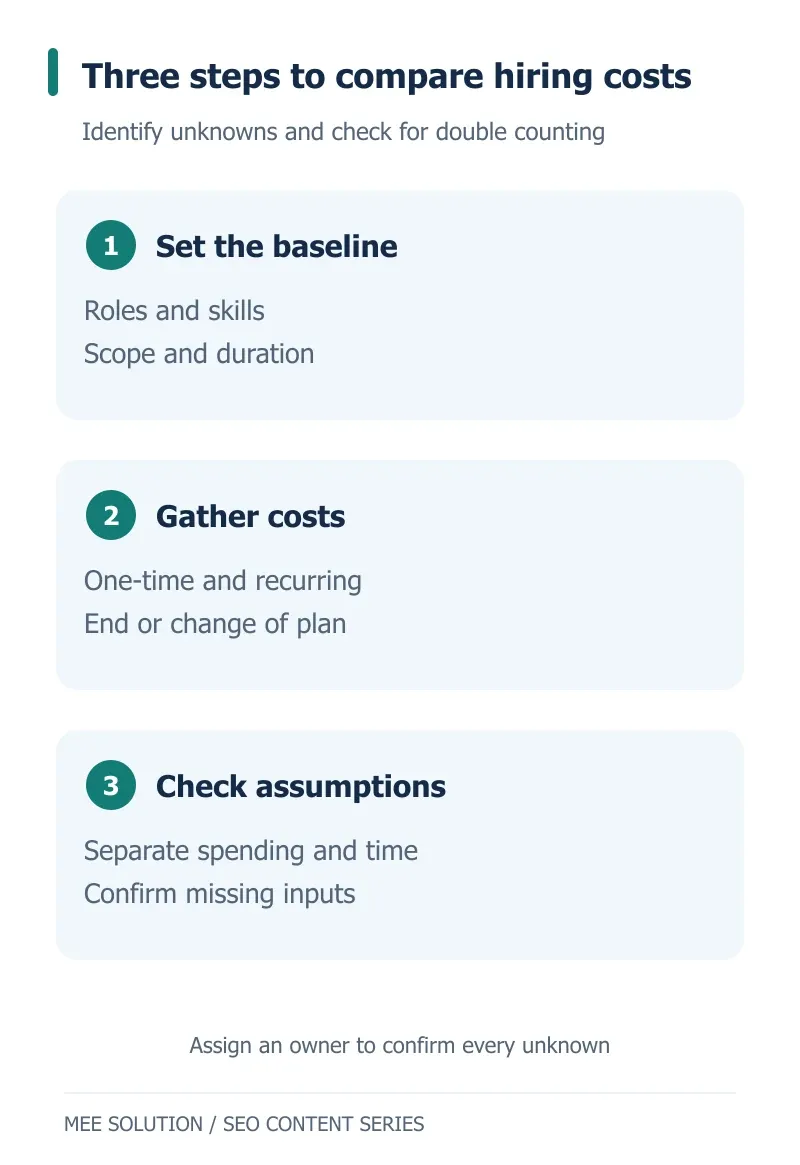
Assign an owner to confirm missing information before deciding.
Define roles, skills, scope, and duration. Gather one-time, recurring, and transition costs, then separate spending from time and check unknowns and double counting.
Mark incomplete information as "pending confirmation" and name the person responsible for confirming it, rather than entering zero. Figures that appear low because information is missing can lead to a poor decision. Review the comparison whenever the scope, duration, or roles change.
Situations in which each option may fit
Adding a specific skill for a limited period
Suppose your team already has a tech lead and QA support but needs additional frontend development for its roadmap. Monthly developer hiring may be worth assessing. Check the skills, availability, task assignment process, and terms for ending the additional support. Include the existing team's time for reviewing the work.
Maintaining core product work over time
If the work depends on business knowledge and long-term system ownership, assess building a permanent team, including staff development and knowledge retention. Consider the capabilities your organization wants to maintain internally in the future alongside the initial costs.
Supporting an existing team during workload increases
An internal team can retain direction and ownership of core systems while external specialists support work with clear boundaries. Prepare shared standards for code, testing, communication, and documentation so that both groups can collaborate and hand work over.
These three situations are hypothetical examples of the decision process. A decision still requires project information and actual proposals.
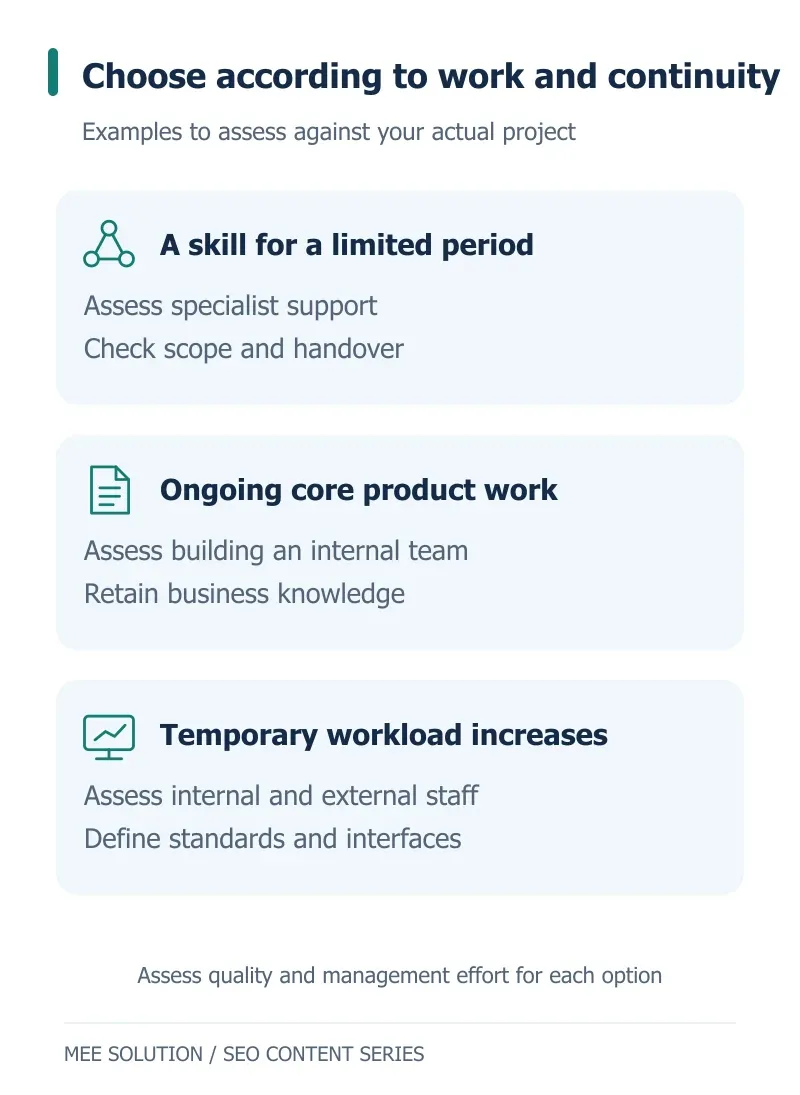
Illustrative situations to assess using project information.
Assess specialist support for limited periods, an internal team for ongoing core work, and combined staffing for workload increases. Review quality, management, and handover for each option.
Assess quality and continuity alongside cost
Use equivalent acceptance evidence for the work being compared. For example, features should meet agreed acceptance criteria, have test results, and complete the required code review. Consistent criteria help reveal the resources each option needs to deliver the expected quality.
For continuity, review how the team maintains documentation, installation procedures, and essential knowledge. Establish who takes over if someone changes roles or leaves the project. Source code alone may be insufficient without operating instructions and the reasoning behind business rules.
Also check system access and who revokes it under your organization's procedures. Plan these responsibilities for both permanent employees and external personnel.
Frequently asked questions
How long should the engagement last to justify the cost
There is no single duration that fits every project. Compare the period in which you expect actual work, initial costs, management effort, and the need to retain skills internally. If the duration remains uncertain, assess several scenarios using information your organization can verify.
Who manages an outsourced developer
It depends on the service scope. When a developer augments an existing team, the client usually still needs to define and prioritize work. Clarify the responsibilities of the product owner, tech lead, and person accepting the deliverables before work begins.
Can we compare only the price per person
Price per person is one input, but also examine responsibilities, experience, scope, and quality evidence. Equal headcount does not establish that the same scope will be delivered. Compare the work required and the resources supporting it.
When should permanent staff and outsourced developers work together
Consider this arrangement when your organization needs to retain direction and some knowledge internally while adding work capacity or skills at particular project stages. Define responsibilities and handover methods so that both groups can work together.
Start with defined work and verifiable costs
The choice between monthly developer hiring and permanent employment should start with the same project needs. Then compare expenses, management effort, quality, and continuity. Assign someone to confirm each unknown so the conclusion reflects the work your organization actually needs to do.
MeeSolution's Workforce service supports both individual specialists and dedicated teams. Discussions begin with your goals, team structure, workflow, and technology stack to assess how the teams could work together. Explore MeeSolution Workforce services
Planning to add development capacity? Prepare your deliverables, required skills, timeframe, and internal team information, then discuss Workforce options with MeeSolution to assess a scope that fits your project.