
Hiring a Software Development Company: What to Prepare Before Requesting a Quote
Prepare a clear custom software brief with 9 essentials covering business goals, users, workflows, integrations, security, budget and acceptance criteria.

Many organizations begin a software project with a need that sounds clear: 'We need a back-office system,' 'We want to rely less on Excel' or 'We need to connect data to our ERP.' Yet when they take the same request to several software development companies, the prices, timelines and scopes can differ so much that comparison becomes difficult.
One reason is that providers may be working from different assumptions. Some proposals include data migration, while others cover only the new system. User permissions, testing and support after launch may not yet be clearly agreed.
Before choosing a custom software development company, prepare a brief that describes the business problem, users, scope and acceptance conditions so everyone is estimating the same work. This article covers the key information you can start with, even without a formal requirements document.
Start with the Business Problem and the Desired Outcome
Before listing features, identify where the current process breaks down, who is affected and how often it happens. Staff may enter the same data into several systems, managers may lack visibility into work status, or documents may wait for approval without anyone knowing whose queue they are in.
Next, define what should change once the system is in place. You may want complete status tracking, fewer duplicate data-entry steps or an audit trail showing who performed each action and when. These goals help the development team understand why features matter and prioritize work around the business.
Use existing information as a baseline where available, such as reporting time, the number of records requiring corrections or approval waiting times. Set targets using the organization's actual data and constraints.
9 Essentials to Prepare Before Requesting a Software Development Quote
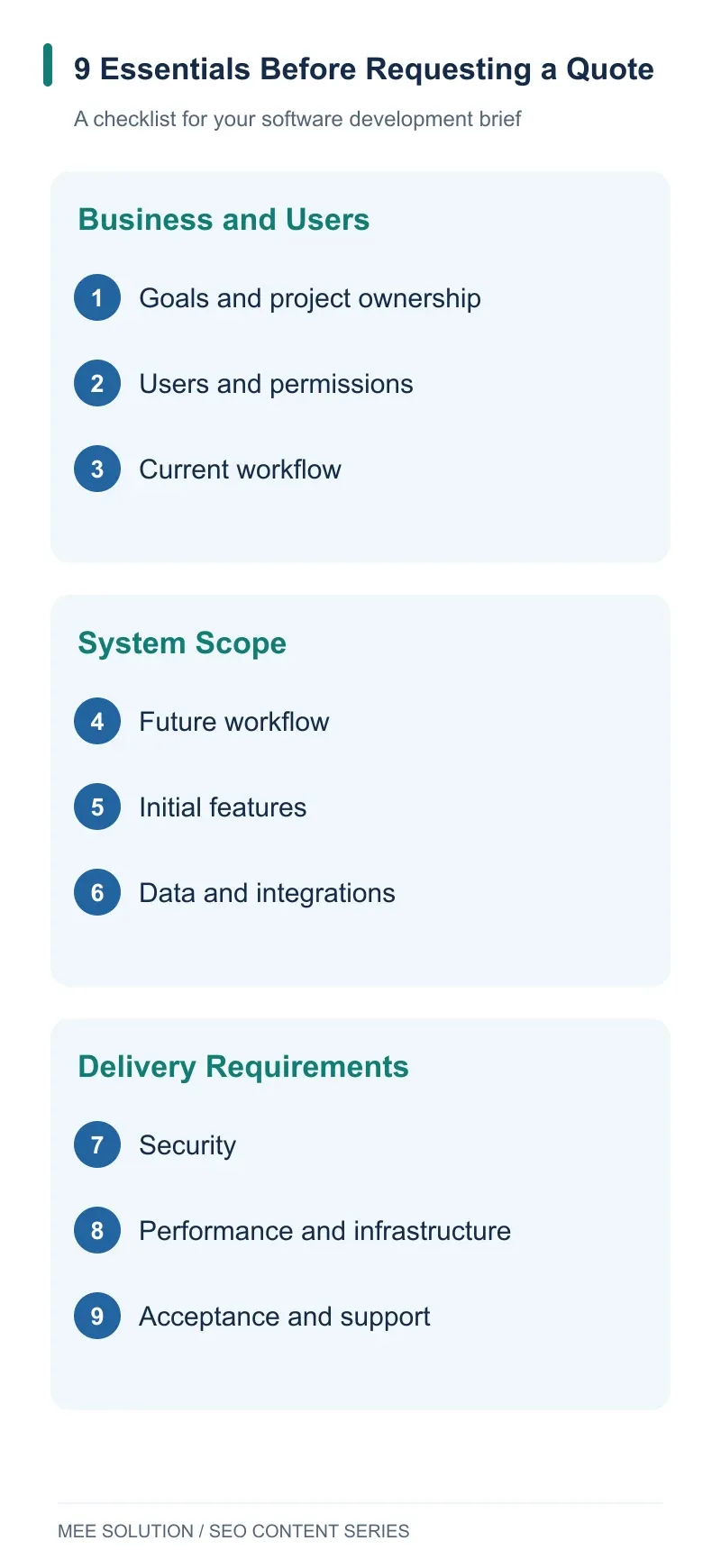
Use this checklist alongside the nine sections explained in the article.
Prepare business goals and project ownership, users and permissions, current and future workflows, initial features, data and integrations, security, performance and infrastructure, and acceptance and support requirements.
1. Business Goals and Project Ownership
Identify the problem to solve, the expected outcome and why the project needs to happen now. Also name the project owner, budget approver and person responsible for requirements decisions.
These responsibilities may belong to different people. Knowing whom to ask about each issue from the outset gives information gathering and scope approval clear owners.
2. Users and Role-Based Permissions
List user groups, such as request creators, approvers, administrators or external partners. Explain what each group does, which data it can see and which information it can change.
Include approximate account numbers and expected concurrent users, as well as cases where one person has several roles. These details affect interface design, permissions and system testing.
3. The Current Workflow
Describe the existing workflow from start to finish: who receives information, who it goes to next, which tools are used and where checks take place. Sample documents or a simple process diagram are enough to start.
Include the workarounds staff currently use, such as resending files through chat, keeping notes in Excel or calling to chase approvers. These practices may reveal needs that are missing from the feature list.
4. The Intended Workflow After Implementation
Explain which steps should stay, which should change and which should be automated. Include exceptions, such as an absent approver, a returned document or incomplete data from a source system.
Describing only the path where everything succeeds is not enough. A production system also needs to support corrections, cancellations, retries and status checks when problems occur.
5. Essential Features and the Initial Scope
Separate features needed for launch from those that can come later, and explain the business reason for each. For example, could the core process still operate without a particular feature?
The first release, or minimum viable product (MVP), should let users complete the selected process from start to finish. Removing essential steps to reduce the feature count may leave a system unusable in practice, even if every listed feature has been developed.
6. Data and Existing Systems to Integrate
List related systems, such as ERP, CRM, HR or accounting platforms. Specify which data must be received, sent or synchronized, who owns it and which dataset should be treated as the authoritative source.
Prepare API documentation, licensing conditions and test environments where available. If this information is not yet available, identify it as an item requiring further assessment so proposals clearly state their assumptions and investigation scope.
7. Security and Data Requirements
Identify the types of data the system will store and process, together with internal requirements for user permissions, sign-in, audit trails, backups and external access.
Involve the IT team or people responsible for data during requirements gathering so important constraints can be assessed before agreeing on the system design and budget.
8. Performance and Infrastructure Requirements
Describe usage hours, transaction volumes, file sizes and situations the system must handle. Examples include concurrent use at the end of a reporting period or processing large datasets within a defined time window.
Rather than saying 'the system must be fast,' identify the process and conditions to assess: which report, how much data and which operating environment. Also disclose constraints involving cloud hosting, on-premises infrastructure or shared authentication systems.
9. Acceptance Criteria and Support After Launch
Specify who will perform acceptance testing, which scenarios will be tested and which deliverables are required, such as user guides, system documentation, training, source code or installation procedures.
Clearly distinguish warranty and maintenance coverage. Agree what counts as fixing a defect in delivered work, what constitutes a new requirement and who will receive and coordinate support requests after launch.
Example: Turning a Broad Request into an Estimable Scope
Suppose an organization wants an 'online document approval system.' That description does not identify document types, approvers, approval rules or integrations. A provider would need to make many assumptions to estimate the work.
A clearer brief might say that a requester creates a record and attaches documents; the system routes it to the department manager and then to an authorized approver based on the approval limit. Once approved, it notifies the relevant departments and keeps a searchable history of actions.
Then add exceptions. If documents are incomplete, an approver can return them with a reason. If an approver is absent, a substitute acts within predefined permissions. Requesters can see only the records they are authorized to access.
This example still needs refinement with users, but it provides enough detail to begin process analysis and ask more focused questions.
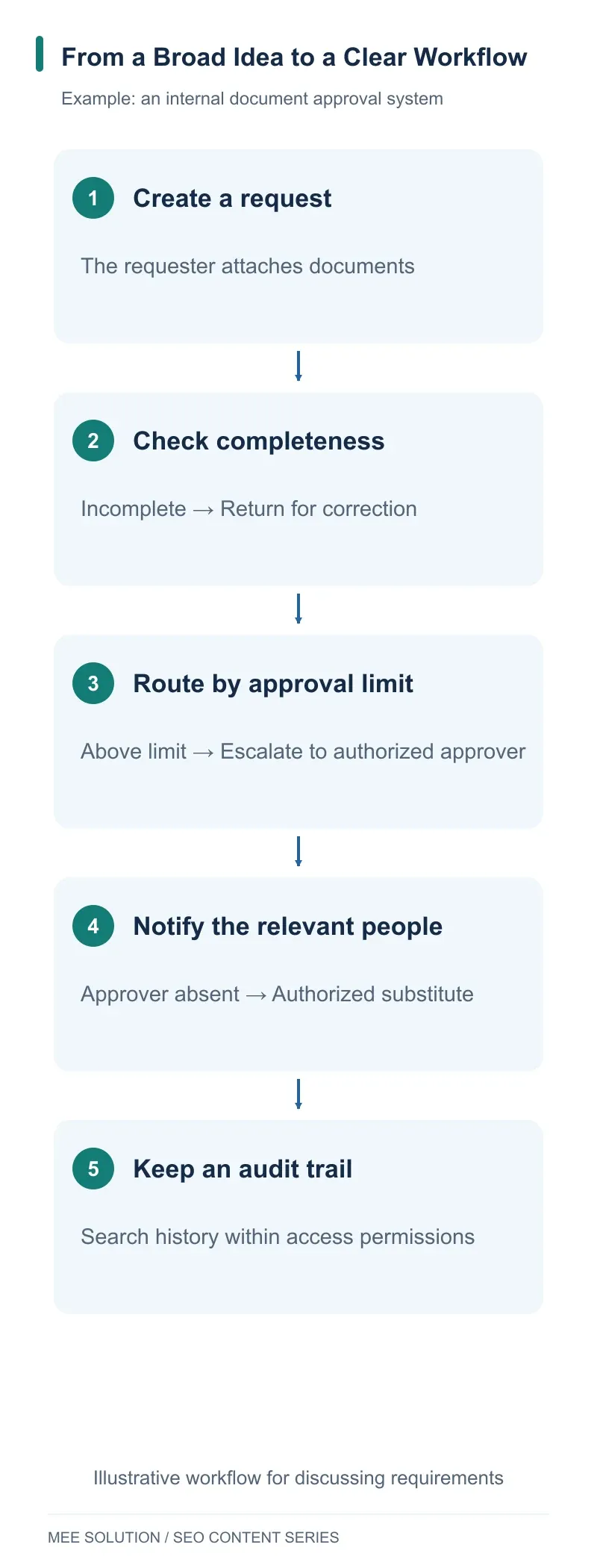
An illustrative workflow for explaining how to prepare requirements.
The requester creates a record and attaches documents. The system then checks completeness, routes approval by authorization limit, notifies relevant people and retains a history. Incomplete documents are returned, amounts above an approver's limit are escalated, and absent approvers are replaced by authorized substitutes.
How Should You Define Budget and Timeline Constraints?
Before requesting proposals, state the budget range and target date together with the business reason, such as opening a new branch or supporting a process change by a particular time. This helps the team propose options and prioritize work within the constraints.
If the full requirements exceed the available budget or time, consider phased delivery. Choose the core process needed first and design later extensions to fit. Phasing must also account for data, integrations and training.
Alongside development fees, ask about recurring costs such as cloud hosting, licenses, messaging services, monitoring and maintenance. Include the internal team's time for answering requirements questions, testing and preparing data. These are part of the resources the project actually needs.
How Can You Compare Providers' Quotes?
Start by checking whether proposals cover the same scope, especially inclusions, exclusions and assumptions. For example, 'ERP integration' might mean importing files periodically or exchanging data through APIs, which involve different work.
Review deliverables at every stage, from requirements gathering and design to development, testing, deployment and support after launch. Each stage should make clear when it is complete, what evidence demonstrates completion and who accepts it.
Also check what the client must provide, such as API documentation, sample data, test environments and approvers. Agree how delays in these dependencies will be assessed against the project schedule.
Before deciding, review the proposal with these questions:
- Are the scope and exclusions clearly defined?
- Are deliverables and acceptance criteria verifiable?
- Who is responsible for data migration and system integration?
- Are one-time and recurring costs shown separately?
- What process applies to requirements changes?
- What support is included after launch?
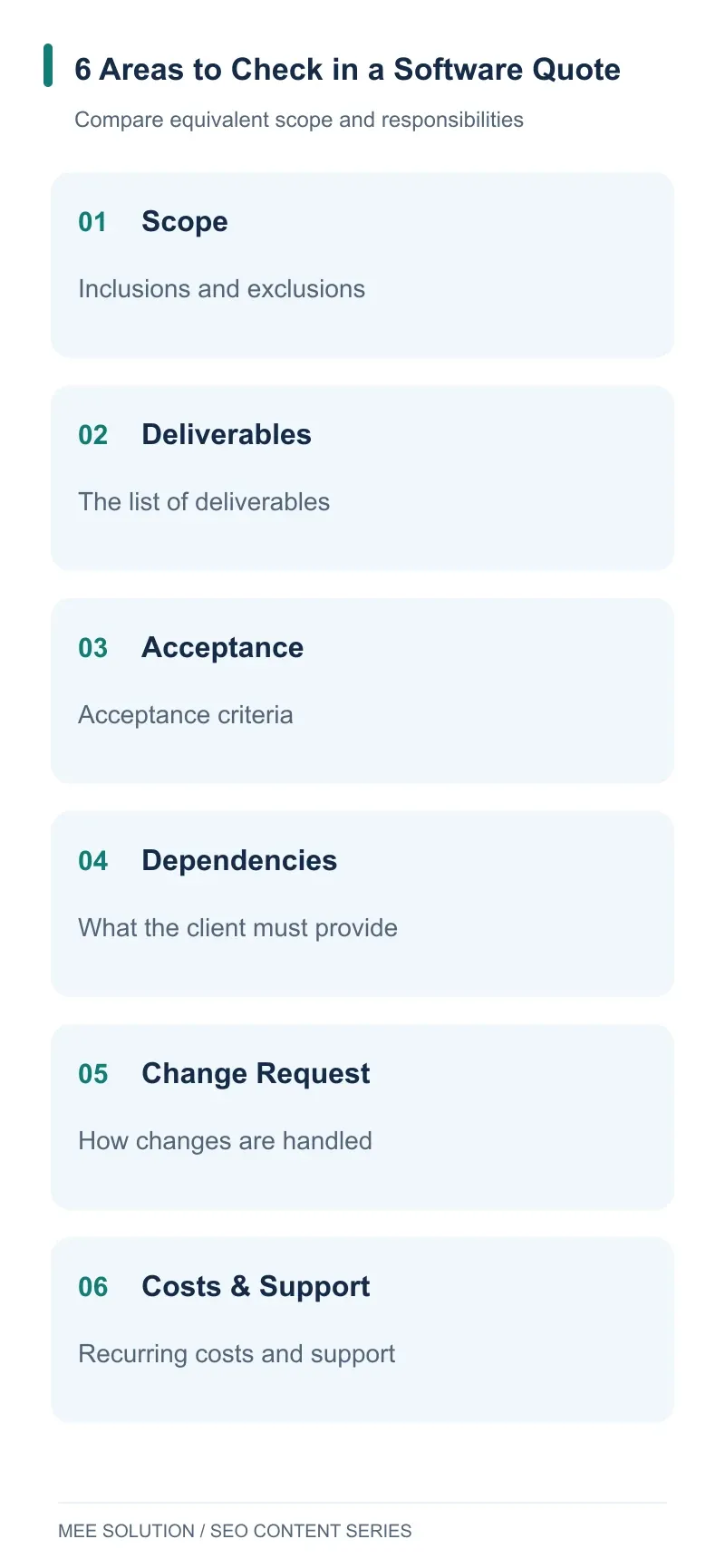
Compare scope and responsibilities as well as price.
Check inclusions and exclusions, deliverables, acceptance criteria, client dependencies, change handling, recurring costs and support coverage.
When Are Fixed Price and Time and Materials Appropriate?
Fixed price sets an agreed fee for a defined scope. It may be worth considering when requirements and acceptance conditions are sufficiently clear. Check assumptions and change handling carefully, because additional requirements may need revised estimates of cost and time.
Time and materials charges for resources and time used under the agreement. It may suit work whose details need to evolve, but requires regular reviews of budget, priorities and outcomes so project owners can decide what to do next.
If there is not yet enough information to define scope, consider a discovery phase to investigate workflows, requirements, integrations and risks before choosing a delivery approach. Agree discovery scope and fees with each provider.
Frequently Asked Questions
Can We Speak to a Software Development Company Without a BRD or Wireframes?
Yes. Start with the business problem, workflows and available sample documents. A provider may be able to give an initial assessment, but detailed pricing and delivery commitments should be based on requirements and assumptions understood by both parties.
How Much Internal Information Should We Share Initially?
Start with the information needed to explain the problem, using examples with sensitive details removed where appropriate. Before sharing real data, agree on responsible parties, access channels and conditions of use under the organization's processes.
How Can We Know Whether the New System Can Connect to Our Existing ERP?
Assess the existing system's capabilities, API documentation, licensing rights, data structure and ERP provider restrictions. If this has not been checked, separate a feasibility assessment from the commitment to a final integration scope.
Who Should Attend Requirements Workshops?
Include process owners, actual users, decision-makers and the relevant IT team. Each contributes different information, such as day-to-day steps, business goals, system constraints and acceptance criteria.
Define the Problem Clearly to Build Software That Fits Your Needs
A useful brief connects business goals, users, workflows, data and acceptance criteria. Clear starting information gives discussions about scope, budget and development options a shared reference.
MeeSolution's Digital Solution services cover custom-built systems, improvements to existing systems and integrations tailored to organizational needs. Start by explaining the business problem and assessing a suitable scope together. Explore Digital Solution services
Planning a software project but unsure what to prepare? Bring your workflows, the problems to solve and the information in this checklist to MeeSolution to begin assessing the project's scope.